What you see in the Catacombs of San Gennaro
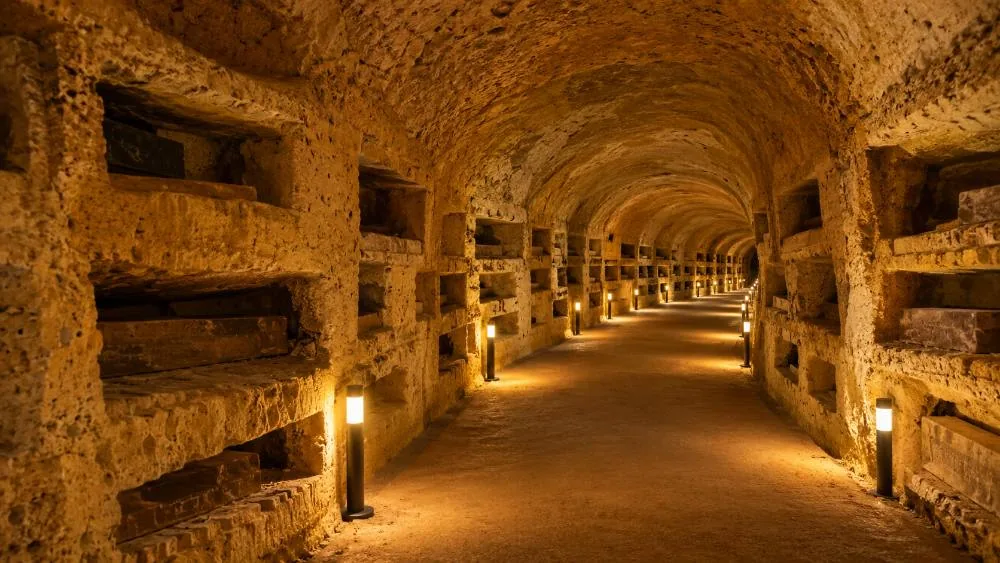
Upper level: the Bishops’ Crypt and the mosaics
We start from the top. The Bishops’ Crypt is the part that strikes visitors the most when they arrive without knowing what to expect: not a narrow passage, but a wide space with high vaults and an underground basilica with three naves carved directly into the rock. The mosaics are here, and among the faces is that of San Quodvultdeus, Bishop of Carthage. The galleries are spacious because the tuff allowed it: this is why this place doesn’t resemble the catacombs you might imagine.
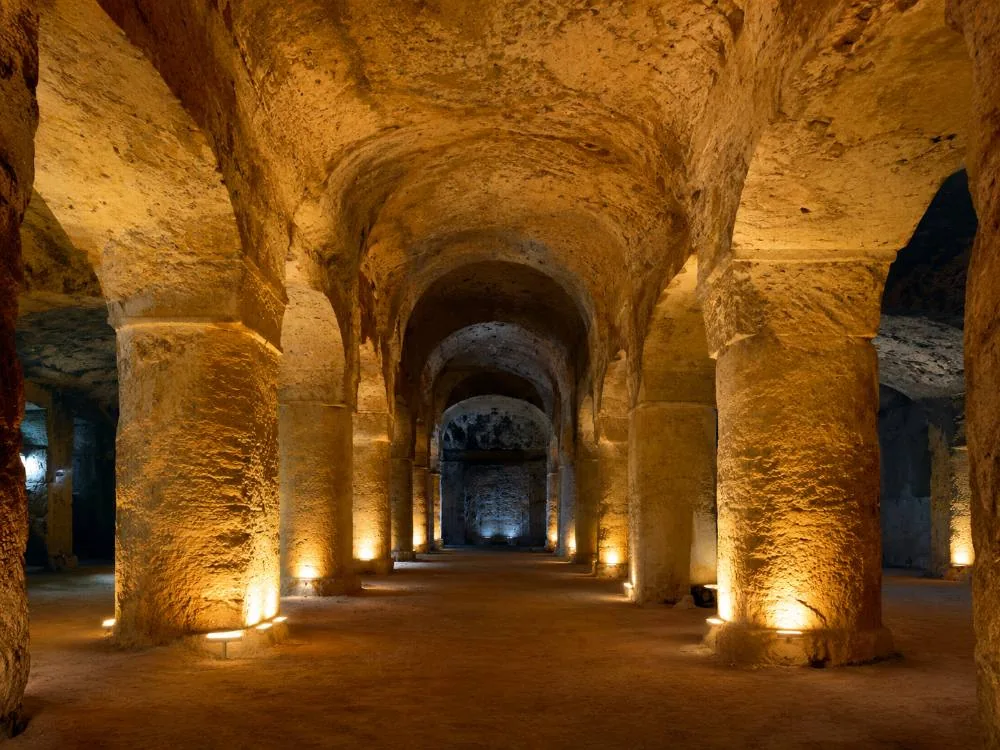
Lower level: the Basilica of Sant'Agrippino
We descend to the second level and the tone changes. Here lies the Basilica of Sant'Agrippino, with the bishop’s throne carved into the rock and the baptismal font: a place where worship truly took place, not just burials. Sant'Agrippino predates San Gennaro; the body of the saint who gave the complex its name was brought here in the 5th century, and from that moment, the cemetery became the city’s great Christian sanctuary. The full story is in history of the catacombs.
The frescoes, and why the dates are so far apart
From the 2nd to the 10th century. Eight centuries of painting on the same walls mean overlapping layers, different hands, and retouching done generations apart. It’s not a unified cycle, and the guide will point out the differences. If you want to know who the person buried at the center of all this was, I’ve written who San Gennaro was.
Photography inside is not allowed: this is a protected site, and the rule applies to everyone. It’s best to know this before descending, so you don’t end up arguing with the guide. The details are in photos can be taken.
What you won’t see here
The vials of blood are not in the catacombs: they are kept in Naples Cathedral, in the Chapel of the Treasure of San Gennaro. Here was the original tomb, which is something else and, in my opinion, the more interesting of the two. I discuss it in the miracle of the blood.
Visiting the two levels with a guide
The full route across both levels is only available with a guided tour, departing at set times. Below are the available dates and times.
Frequently asked questions
How many levels do the Catacombs of San Gennaro have?
Two, connected to each other and carved into the tuff. Above is the Crypt of the Bishops, the three-naved basilica, and the mosaics; below is the Basilica of Sant'Agrippino. The visit lasts about an hour.
Is San Gennaro’s tomb in the catacombs?
The original tomb was here: the saint’s body was brought into these galleries in the 5th century. The vials of blood, however, are kept in Naples Cathedral. I explain the difference in the miracle of the blood.
From which era are the frescoes?
They span a long period, from the 2nd to the 10th century, with overlapping layers on the same walls. The historical context is in the history of the catacombs.
Is the route tiring?
Little: about half a kilometer, almost entirely flat, through wide galleries. It’s the most comfortable underground in Naples to walk through, as I explain in which underground Naples to choose.