The history of the Catacombs of San Gennaro
Why they dug right here
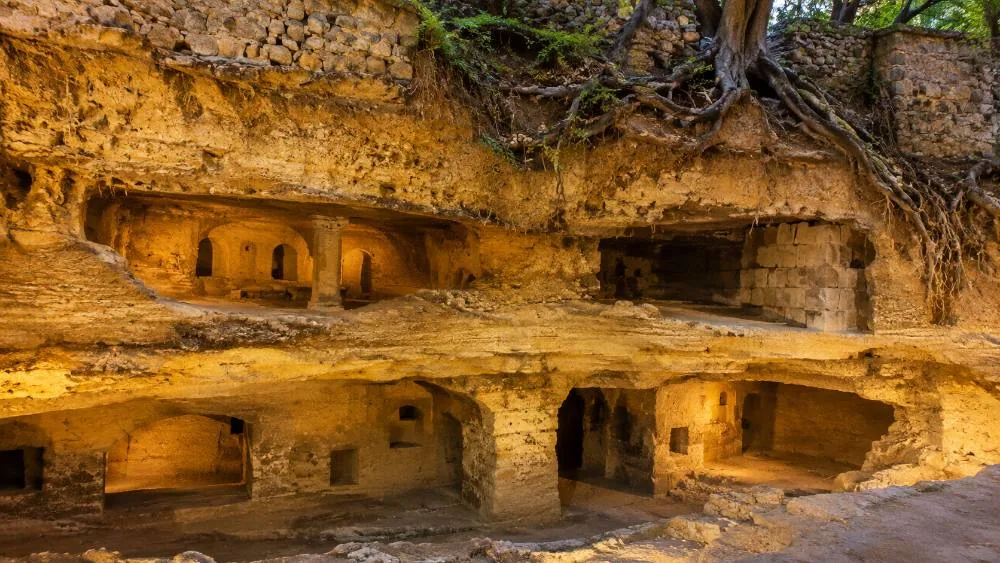
The yellow tuff of Capodimonte cuts easily and holds well. That is why these galleries are wide and tall instead of narrow: those who dug could afford it. The area was outside the city walls, as was customary for Greek and Roman cemetery sites, and this is the same reason why the neighborhood below began as burial grounds before becoming residential. The rest of the district's history is in the Rione Sanità.
Two levels, two periods
The complex spans two connected floors. Above lies the Crypt of the Bishops and the three-naved underground basilica, with mosaics including one depicting San Quodvultdeus. Below is the Basilica of Sant'Agrippino, featuring a bishop's throne carved directly into the rock and a baptismal font: signs of a place where ceremonies were held, not just burials. I wrote the route with the names in their proper places in what you see underground.
The 5th century, when everything changes
The body of San Gennaro, Bishop of Benevento martyred in the early 4th century, is transferred to these galleries in the 5th century. From then on, it is no longer just another cemetery: it becomes Naples' Christian sanctuary, the destination toward which the city ascends. It is also the moment when the complex takes the name it still bears today. I wrote separately about the saint in who San Gennaro was.
Eight centuries of painted walls
The frescoes date from the 2nd to the 10th century, meaning that hands separated by generations worked on the same surfaces. There is no single plan: there are layers, revisions, and overlaps. This is the part that a well-prepared guide makes understandable, which would not be clear on one's own, and it is one of the reasons why here entry is guided only.
The tomb of San Gennaro was here; the vials with his blood, however, are in the Duomo, in the Chapel of the Treasury. These are two different places, and the confusion is common: I discuss it in the miracle of the blood.
The reopening and the cooperative
For a long time, these galleries were closed, and the neighborhood above and below remained isolated from the rest of the city. The young people of the social cooperative La Paranza, born in the Sanità district, were the ones who restored them. Since then, the guided tour has been the economic engine of the district, not an external service imposed from above. This is the most concrete reason I know to book the visit instead of just looking at photographs: the ticket stays in the neighborhood.
Seeing the two underground basilicas
The historical narrative is the best part of the visit, and the guide delivers it on-site. Below, you will find the available departures.
Frequently asked questions
From which period are the Catacombs of San Gennaro?
The frescoes span from the 2nd to the 10th century; the complex becomes the city's Christian sanctuary in the 5th century when the saint's body is brought here. The underground route is described in what you see.
Why are they so wide compared to other catacombs?
Because they are carved into the tuff of Capodimonte, which holds well: it was possible to create wide galleries and even two underground basilicas. This is also why the route is almost entirely flat, as you can see in what you see underground.
Who manages the catacombs today?
The social cooperative La Paranza, born in the Rione Sanità. I explain the connection between the visit and the neighborhood in the Rione Sanità.
Can they be visited without a guide to read at your own pace?
No: entry is only with a guided tour, at scheduled times and by reservation. The opening times and rules do not allow free access.